The machine humming in a laboratory in 1984 bore little resemblance to today’s sleek desktop printers, yet Chuck Hull’s stereolithography apparatus contained the seed of a manufacturing revolution.
Four decades later, 3d printing has matured from a niche prototyping curiosity into a technology that builds jet engine components, prosthetic limbs, and even houses.
This guide cuts through the hype to deliver the facts you actually need—whether you’re evaluating your first prototype order or scaling to low-volume production.
Key Takeaways
Before diving into the details, here are the headlines that matter most:
3D printing is not new. The foundational patents date to the early 1980s, predating the world wide web. Mass adoption accelerated only after key patents entered the public domain around 2009, unleashing an explosion of affordable desktop printers.
Materials go far beyond plastic. Today’s additive manufacturing processes work with metals like titanium and Inconel, engineering nylons, flexible elastomers, food-grade ingredients, and even living cells for bioprinting research.
Real-world milestones prove commercial viability. General Electric flies FAA-certified 3D printed fuel nozzles in its LEAP engines, NASA prints tools aboard the international space station, and construction firms print entire house walls in days.
On-demand services democratise access. Companies like 3DMITECH LTD turn a cad file into production-ready parts shipped within 24–72 hours, eliminating the need for expensive in-house equipment or lengthy tooling lead times.
Limitations still exist. For high-volume runs, traditional manufacturing methods like injection molding remain more cost effective once tooling is amortised. Surface finish, dimensional tolerances, and material property limits require honest evaluation.
3D Printing Is Older Than You Think
Most people assume 3d printing emerged alongside smartphones and social media. In reality, its roots stretch back more than four decades—well before the world wide web reshaped communication.
Early Concepts (1940s–1970s)
Science-fiction author Murray Leinster described a machine that builds three dimensional objects from instructions in his 1945 story Things Pass By. By 1971, Johannes F. Gottwald filed his own patent for a “liquid metal recorder” that could deposit molten material in patterns—an early conceptual ancestor of modern extrusion methods.
The First Working System (1981)
Japanese researcher Hideo Kodama at the Nagoya Municipal Industrial Research Institute demonstrated a functional rapid-prototyping system in 1981. His device used uv light to cure photosensitive resin layer by layer, establishing the core principle that still drives vat photopolymerisation today.
Chuck Hull and the Birth of SLA (1984–1988)
Chuck Hull filed his stereolithography patent in 1984 and later co-founded 3D Systems. By 1987–1988, the company shipped the first commercial 3D printer. Hull also invented the .STL file format, which remains the de-facto standard for transferring digital files to printers.
Scott Crump and Fused Deposition Modeling (1989)
Scott Crump filed his first patent for fused deposition modeling in 1989, later founding Stratasys to commercialise the technology. FDM—also known as fused filament fabrication in open-source communities—evolved into the most common method powering today’s desktop printers.
From “Rapid Prototyping” to “Additive Manufacturing”
What we now call additive manufacturing started life as rapid prototyping, a term that emphasised speed over end-use production. Early systems lived in corporate R&D labs with six-figure price tags. The expiration of core patents around 2009 opened the floodgates for affordable hardware, transforming a specialist tool into an accessible technology for engineers, designers, and hobbyists alike.
From Prototypes to Production: What 3D Printing Really Does
At its core, 3d printing is a family of manufacturing processes that create physical objects by adding material in thin layers rather than carving it away. Let’s unpack how that actually works.
The Layer-by-Layer Principle
Traditional methods like CNC machining remove material from a solid block—a subtractive manufacturing approach. Additive manufacturing does the opposite: it deposits or solidifies raw material one cross-section at a time until the part is complete. This distinction enables complex geometries that would be impossible or prohibitively expensive to machine.
The Digital-to-Physical Workflow
Design – Create a 3D model using CAD software or capture a physical object with a 3D scanner.
Export – Save the design as a digital model, typically in .STL or .OBJ format.
Slice – Slicer software divides the model into hundreds or thousands of horizontal layers and generates G-code instructions.
Print – The printer follows the G-code to produce parts, whether by extruding plastic, curing resin, or fusing powder.
Post processing – Depending on the process, parts may need support removal, curing, sanding, or other finishing steps.
Three Main Process Families
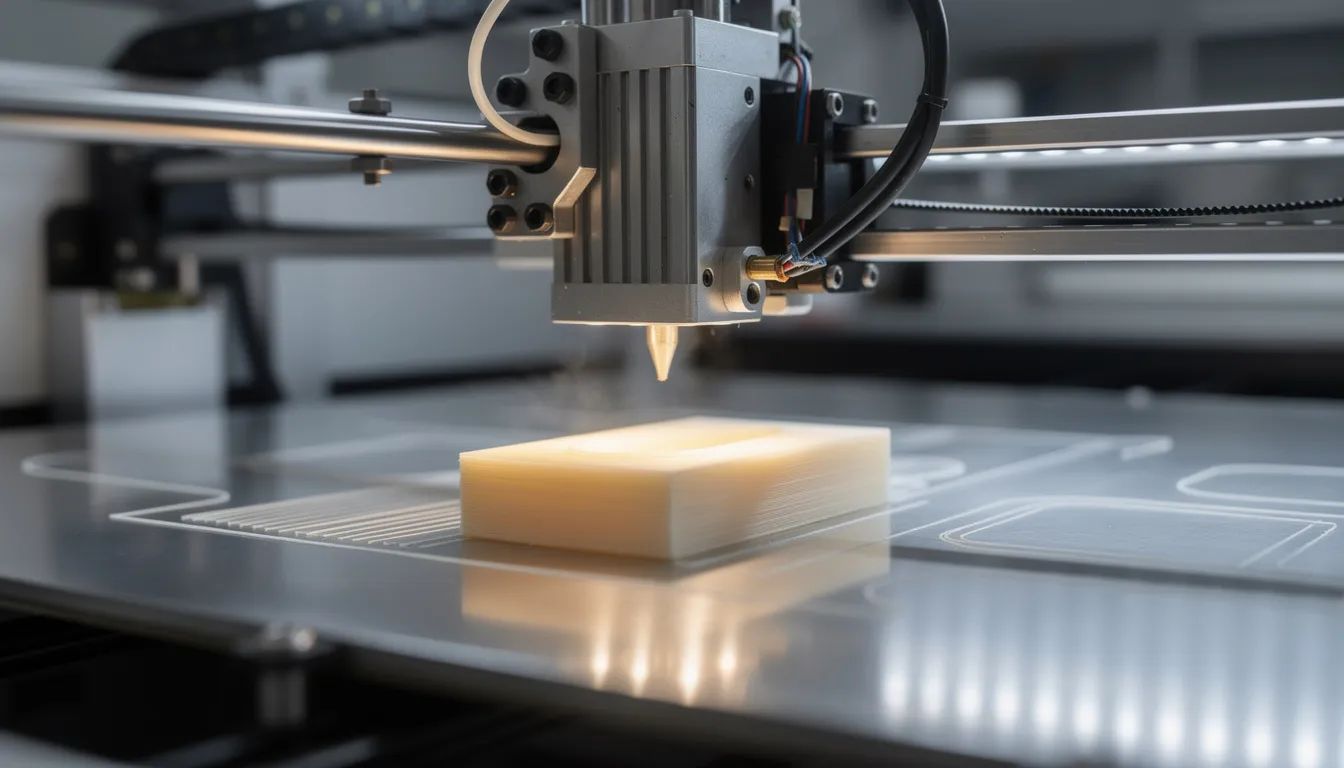
There are three main process families in 3D printing, each working in a unique way to build parts layer by layer. The first is Material Extrusion, where heated thermoplastic filament is pushed through a nozzle onto a build platform, depositing thin layers that solidify to form the object.
This process is commonly known as Fused Deposition Modeling (FDM) or fused filament fabrication. The second process family is Vat Photopolymerisation, which uses a light source such as a laser or projector to selectively cure liquid resin in a vat, solidifying it layer by layer; technologies like Stereolithography (SLA) and Digital Light Processing (DLP) fall under this category.
Lastly, Powder Bed Fusion involves a laser or electron beam that fuses powder particles into solid layers, creating dense and precise parts. This category includes selective laser sintering (SLS), multi-jet fusion (MJF), selective laser melting (SLM), direct metal laser sintering (DMLS), and electron beam melting (EBM).
Each of these additive manufacturing processes offers different advantages depending on the material used and the intended application.
Services like 3DMITECH LTD’s fast on-demand manufacturing operate multiple additive manufacturing technologies—FDM, SLA, SLS, MJF, and SLM—so customers can match the right technology to their application and budget.
3D Printing vs Additive Manufacturing: What’s the Difference?
Technically, “additive manufacturing” is the ISO-standard industrial term, while “3d printing” entered popular vocabulary through media coverage of desktop machines. Today, the phrases are effectively interchangeable, though “AM” often appears in aerospace and medical contexts where certification language matters.
Complements, Not Replaces
3D printing excels at faster prototyping, complex designs, and low-volume runs. For medium to high volumes—typically beyond a few hundred to a few thousand parts—traditional manufacturing methods like injection molding or die casting usually deliver a lower cost per part once tooling is amortised. Smart manufacturers use both: print to validate, then transition to mass production tooling when volumes justify it.
Beyond Plastic: Surprising 3D Printing Materials
If you still picture 3d printing as synonymous with brittle plastic trinkets, it’s time to update your mental model. Modern additive manufacturing processes work with an astonishing range of materials.
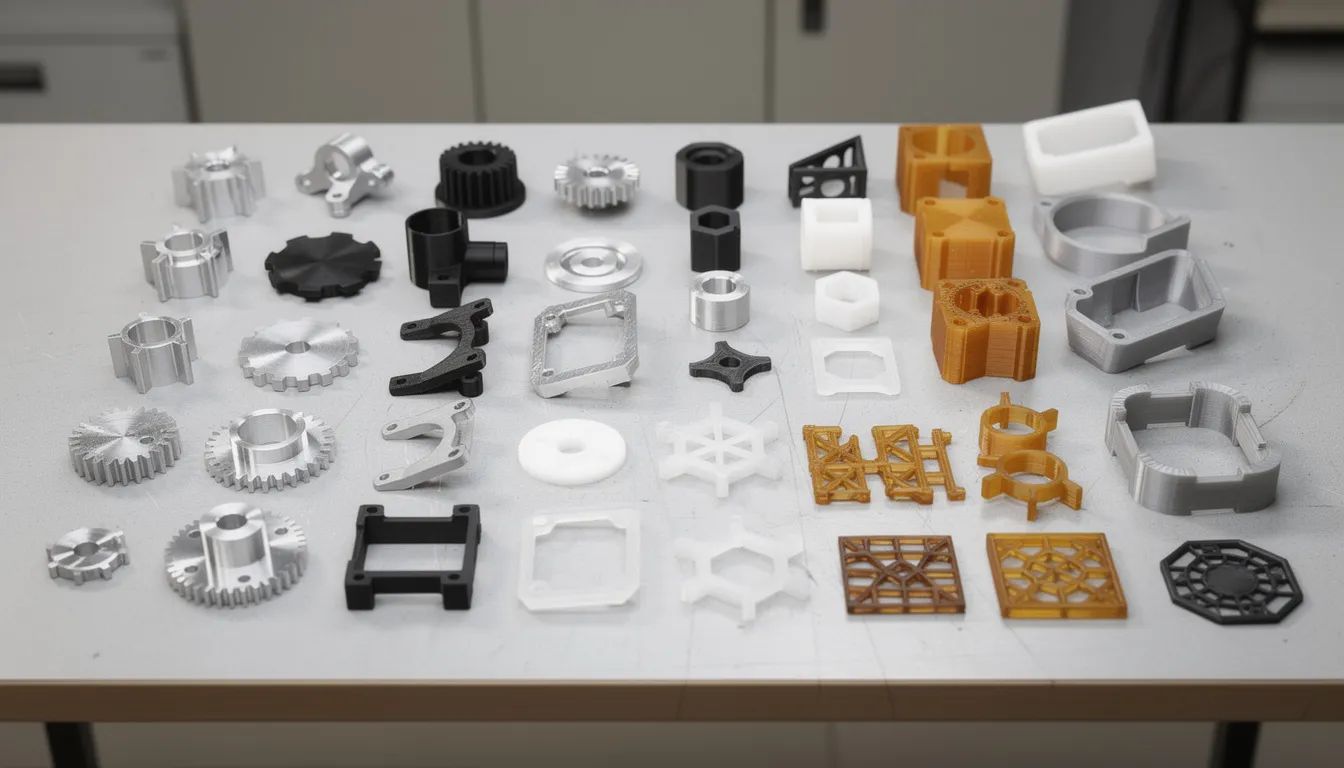
Material selection is a crucial step in 3D printing, as different materials offer varying properties suited to specific applications. Commonly used materials include PLA, known for being biodegradable, low warp, and easy to print, making it ideal for concept models and visual prototypes.
ABS offers durability, heat resistance, and toughness, suitable for functional prototypes and housings. PETG provides chemical resistance and food-safe options, often used for bottles, containers, and fixtures.
Polycarbonate (PC) is valued for its high impact strength and availability in transparent grades, commonly employed in lenses and protective covers.
Nylon variants like PA11 and PA12 are strong, flexible, and wear-resistant, making them perfect for gears, hinges, and snap-fits. TPU is flexible with rubber-like elasticity, used in applications such as gaskets, grips, and wearable items.
Metal Additive Manufacturing
Selective laser melting and direct metal laser sintering fuse metal powder with lasers to produce parts with densities exceeding 99%. Examples include:
Titanium cranial plates match patient anatomy, reducing surgery time by up to 30%.
Inconel turbine components for jet engines are capable of withstanding extreme temperatures.
Lightweight aluminium brackets for aerospace and motorsport, where every gram matters.
ESD-safe materials protect sensitive electronics during handling.
Flame-retardant grades meet aerospace and rail interior certifications.
High-temperature resins serve as tooling masters for thermoforming and composite layup.
Ceramics and Sand
Binder jetting can produce objects from ceramic powders or sand, enabling:
- Investment casting patterns for jewellery and precious metals.
- Sand molds for metal casting without traditional patternmaking lead times.
The Unexpected: Food and Bio-Inks
Edible printing uses chocolate, sugar, and dough to create intricate confections for the food industry.
Bio-inks containing living cells allow researchers to print tissues, cartilage scaffolds, and even structures mimicking blood vessels for regenerative medicine studies.
When selecting materials, focus on application requirements—mechanical properties, temperature resistance, surface finish—rather than defaulting to the cheapest option. A service like 3DMITECH LTD can recommend the best fit after reviewing your design and performance needs.
Unexpected Places You’ll Find 3D Printing Today
3D printing is no longer confined to engineering labs. Walk through an airport, visit a dental clinic, or attend a motorsport event, and you’ll encounter parts printed layer by layer.
Automotive and Motorsport
Car manufacturers use 3d printing to prototype nearly every new component before committing to tooling. Beyond prototypes:
Lattice brackets reduce weight while maintaining strength in performance vehicles.
Divergent’s Blade hypercar features a chassis built largely from 3D printed aluminium nodes joined by carbon-fiber tubes.
Spare parts for classic cars can be recreated from scans when original tooling no longer exists.
Aerospace
General Electric’s LEAP jet engine contains 19 fuel nozzles per engine, each 3D printed as a single piece instead of 20 welded components. FAA certification in 2016 marked a watershed moment for additive manufacturing in flight-critical applications. Airbus and Boeing integrate lightweight printed brackets and ducts across their fleets, trimming fuel consumption over millions of flight hours.
Healthcare
Medical applications span the full patient journey:
Surgical guides derived from CT and MRI scans help surgeons plan bone cuts with sub-millimetre precision.
Custom orthopedic implants in titanium match patient anatomy perfectly.
Hearing aids — over 90% of in-ear shells are now produced via 3d printing.
Dental aligners rely on printed molds or direct-printed trays.
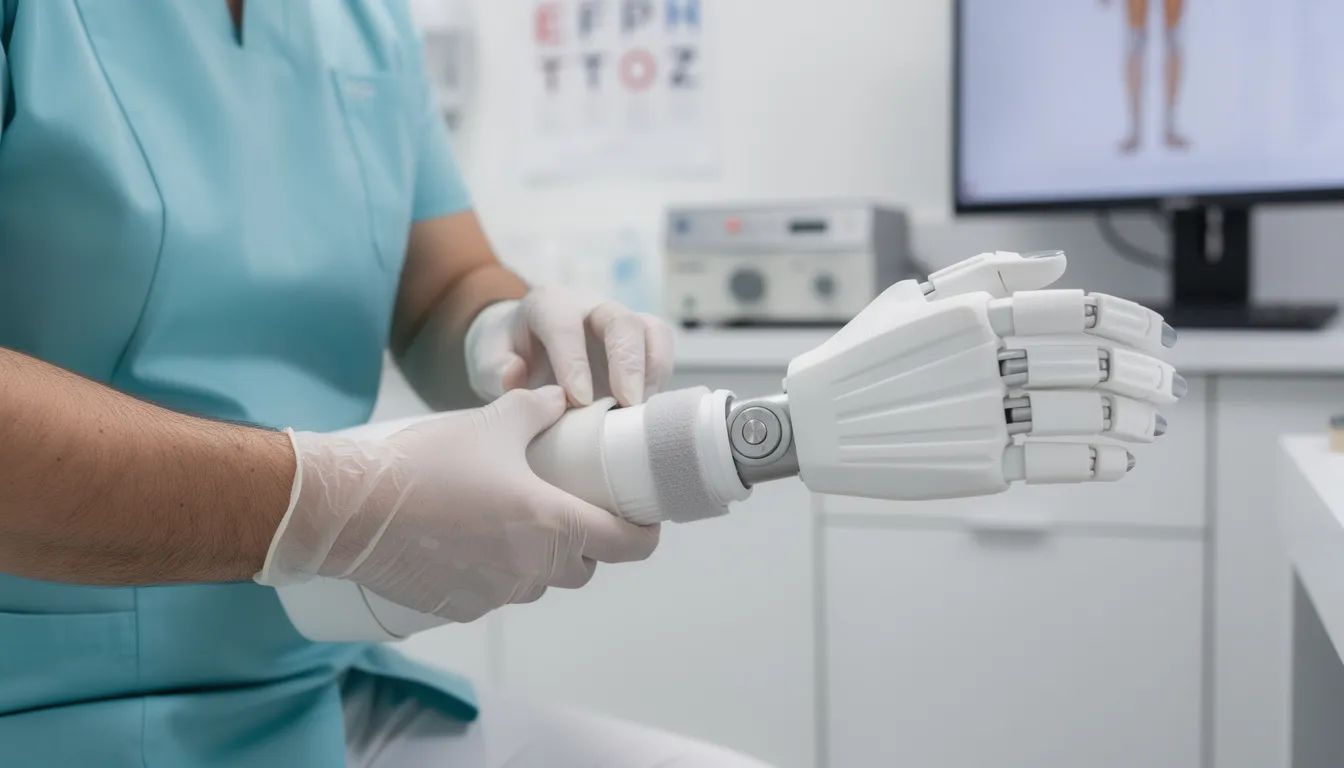
Prosthetics for both humans and animals can be produced for a fraction of traditional costs.
Consumer and Fashion
Footwear brands print lattice midsoles tuned to an athlete’s gait and weight.
Eyewear manufacturers produce custom-fit frames on demand.
Jewellers print wax or resin patterns for investment casting, with up to 90% of cast pieces now starting from a 3D printed master.
Services like 3DMITECH LTD support these sectors by turning CAD files into prototypes or on-demand spare parts with lead times as fast as 24 hours for some materials.
3D Printing Off-Planet and at Architectural Scale
Space habitats and multi-storey buildings may sound like science fiction, but they’re already in progress.
Tools on the International Space Station
In 2014, NASA installed a 3D printer aboard the International Space Station. Astronauts printed a ratchet wrench on demand, demonstrating that crews could produce objects directly in microgravity rather than waiting months for the next resupply mission. Since then, experiments have expanded to print directly with recycled plastics and even regolith simulants.
Printing Habitats on the Moon and Mars
NASA’s Ice House concept envisions translucent structures printed from Martian ice, while ESA has tested binder jetting with simulated lunar regolith to create bricks. The vision: land robotic printers ahead of human crews and build houses using local raw material, slashing the mass that must be launched from Earth.
Sustainability and Efficiency: Facts Behind the Hype
Additive manufacturing often gets positioned as an inherently “green” technology. The reality is more nuanced.
Reduced Material Waste
Subtractive manufacturing starts with a solid block and removes material until the desired shape remains—sometimes discarding 80–90% of the original stock. In contrast, 3d printing deposits material only where needed. For geometries with lots of internal voids or lattice structures, savings can be dramatic.
Lightweight Designs Save Fuel
Topology-optimised lattice structures can cut component mass by 50–70% while maintaining strength. In aerospace and automotive applications, every kilogram saved translates to fuel savings over the product’s lifetime—often measured in tonnes of CO₂ avoided.
Recycling and Closed-Loop Initiatives
PLA prints can be ground into pellets and re-extruded as new filament, though mechanical properties may degrade with each cycle.
SLS nylon powder is partially reused in subsequent builds, reducing virgin material demand.
Some facilities collect failed prints and offcuts to feed industrial recycling streams.
Trade-Offs to Acknowledge
Energy consumption for laser-based powder bed fusion processes can exceed CNC machining for equivalent small parts.
Metal powders require controlled atmospheres and careful handling; recycling routes are less mature than for bulk metals.
Resin waste from vat photopolymerisation must be disposed of responsibly.
On-Demand and Local Production
When services like 3DMITECH LTD’s Halifax-based 3D printing produce parts on demand, manufacturers avoid warehousing large inventories. Localised production shortens supply chains, reducing transport emissions and the risk of obsolete stock.
How Companies Actually Use On-Demand 3D Printing Services
Many organisations never purchase an industrial printer. Instead, they rely on online services for flexibility, speed, and access to multiple materials and additive manufacturing technologies without capital expenditure.
Confirm Order – Secure checkout with NDA-backed IP protection for sensitive designs.
Production – Parts printed on calibrated industrial equipment.
Delivery – Finished parts shipped, often within 24–72 hours for standard materials.
Rapid Prototyping
Engineers iterate design versions in days rather than weeks. A concept model printed via fused deposition modeling (FDM) can validate ergonomics by Monday, followed by a high-resolution stereolithography (SLA) prototype arriving within 8 days for client review—especially when leveraging 3DMITECH LTD’s rapid prototyping services. This accelerated workflow compresses development cycles, reduces risk, and enables faster decision-making before committing to tooling.
Low-Volume Production
For runs of tens to a few thousand units, SLS or MJF delivers strong nylon parts without mold costs. Startups launching on crowdfunding platforms often use this route to fulfil early backers while tooling is still being cut, relying on 3DMITECH LTD’s UK on-demand 3D printing to bridge the gap.
Functional Metal Parts
SLM produces parts printed in stainless steel, aluminium, or titanium for brackets, jigs, fixtures, and custom end-effectors. Low-volume aerospace and motorsport components frequently follow this path, taking advantage of 3DMITECH LTD’s rapid metal 3D printing services.
Additional Service Expectations
IP Protection – NDAs and secure file handling safeguard customer designs.
Basic Finishing – Support removal, bead blasting, or vapour smoothing for improved surface finish.
On-Demand Reordering – No need to stock inventory; parts can be reordered as needed with consistent quality from 3DMITECH LTD’s Reading 3D printing hub.
3D Printing and Human/Animal Health: Beyond Headlines
Medical and conservation applications make for dramatic headlines, but separating reality from research-stage promises is essential.
Surgical Planning Models
Surgeons use 3D printed anatomical models derived from patient CT or MRI scans to rehearse complex operations. Studies report reduced theatre time and improved outcomes for cranial, cardiac, and orthopaedic procedures. These surgical guides are now routine in major hospitals.
Low-Cost Prosthetics
Open-source designs and desktop FDM enable NGOs to produce own parts for prosthetic hands at material costs under £50. Organisations like e-NABLE coordinate global networks of volunteers who print and fit devices for patients in low-resource settings.
Animal Conservation
3D printed beaks have restored feeding ability to injured eagles and toucans.
Turtle shell repairs use printed patches bonded to damaged carapaces.
Replica eggs help conservation researchers study nesting behaviour without disturbing real clutches.
Bioprinting: What’s Real Today?
Full transplantable organs remain in R&D. However, laboratories have demonstrated bioprinted cartilage scaffolds, skin grafts, and vascular structures containing blood vessels. Cellink’s bio-ink, launched in 2015, commercialised the printing of living cells for research purposes.
Crisis Response
During the COVID-19 pandemic, decentralised 3d printing networks produced personal protective equipment—face shields, mask frames, and ventilator splitters—when traditional manufacturing chains stalled. This demonstrated the resilience of distributed, on-demand production.
Key Limitations and Myths to Be Honest About
Despite the hype, 3d printing is not a magic box that instantly and cheaply makes “anything” at home. Here’s a reality check.
Desktop vs Industrial Machines
Entry-level desktop printers cost a few hundred dollars and produce objects suitable for prototypes, hobby parts, and visual models. Industrial machines costing tens or hundreds of thousands of dollars deliver tighter tolerances, stronger mechanical properties, and repeatable quality batch after batch. Expecting consumer hardware to match industrial output leads to disappointment.
Economic Break-Even
For medium to high volumes, injection molding or die casting beats 3d printing on cost per part once tooling is amortised. The crossover point depends on part size, complexity, and material, but often falls somewhere between a few hundred and a few thousand units.
Tolerances and Surface Finish
Typical polymer processes achieve tolerances of ±0.1–0.3 mm; metals can be tighter with tuned setups. Layer lines remain visible on most parts without post-processing such as sanding, vapour smoothing, or painting. Critical mating surfaces may still require CNC finishing.
Health and Safety
Ultrafine particles and VOCs are emitted by some polymers, especially ABS. Enclosed printers with filtration and adequate ventilation are essential in industrial environments.
Metal powder handling requires personal protective equipment, inert atmospheres, and explosion-prevention protocols.
Resin handling demands gloves and eye protection; uncured resin is a skin sensitiser.
When to Choose Other Methods
A reputable service like 3DMITECH LTD will advise when 3d printing is truly the right technology—and when customers should consider alternative manufacturing methods such as CNC machining, sheet-metal fabrication, or injection molding. Honest guidance saves time and money.
FAQ
How do I know which 3D printing process and material to choose?
Selection depends on your application (prototype vs end-use), required strength, temperature and chemical resistance, surface finish expectations, and budget.
Rules of thumb:
FDM – Fast, low-cost prototypes; larger parts where fine detail isn’t critical.
SLA – Fine detail, smooth surfaces; ideal for visual models, dental, and jewellery patterns.
SLS / MJF – Strong nylon functional parts without support structures; good for snap-fits and hinges.
SLM / DMLS – Metal components for aerospace, medical, or high-stress applications.
3DMITECH LTD provides material and process recommendations after reviewing customer CAD files and performance needs.
Can 3D printing really replace injection molding for my product?
3D printing is ideal for rapid prototyping and low-volume production—usually up to hundreds or a few thousand units, depending on part size and complexity. For large volumes, injection molding remains more cost effective once the cost of a steel or aluminium mold is justified.
Many customers use 3DMITECH LTD for bridge production: fulfilling early market runs while tooling is still being developed, then transitioning to molding as demand scales.
How accurate and strong are industrial 3D printed parts?
Accuracy varies by technology:
Technology tolerances vary depending on the method used:
- Fused Deposition Modeling (FDM) typically achieves dimensional accuracy within ±0.2 to 0.5 mm.
- Stereolithography (SLA) offers finer precision, usually around ±0.1 to 0.2 mm.
- Selective Laser Sintering (SLS) and Multi Jet Fusion (MJF) processes generally maintain tolerances between ±0.1 and 0.3 mm.
- Selective Laser Melting (SLM), used for metal parts, can achieve tolerances as tight as ±0.05 to 0.2 mm.
Mechanical strength of 3D printed parts can match or even exceed that of machined components for certain geometries and materials, especially with nylon SLS or metal SLM. Achieving reliable results depends heavily on proper design for additive manufacturing, including considerations like wall thickness, fillet radii, and alignment with load paths.
How quickly can I get 3D printed parts delivered?
Lead times vary by technology, material, and quantity. Simple polymer parts often ship within 24–72 hours from services like 3DIMITECH LTD. More complex metal builds or large batch orders may take several working days due to build scheduling, post processing, and quality checks.
Use instant online quoting tools to see real-time lead times and pricing for your specific designs.
Is my intellectual property safe when I upload CAD files?
Reputable services implement NDAs, secure file handling, and restricted internal access to protect customer designs. 3DMITECH LTD operates as an online manufacturer with IP protection policies and can sign project-specific NDAs for sensitive parts.
Always request documentation of security and confidentiality measures when working with any external 3d printing provider.
Ready to Turn Your Design into Reality?
Whether you’re validating a concept, producing spare parts on demand, or scaling to low-volume production, the facts in this guide should help you make smarter decisions. 3D printing has come a long way since Chuck Hull’s first patent—and the latest technologies continue to push boundaries in materials, speed, and scale.
If you’re ready to move from CAD to physical parts, upload your digital files to 3DMITECH LTD’s Cardiff 3D printing service for an instant quote. With multiple materials and additive manufacturing technologies under one roof, you’ll find the right solution for prototypes, functional testing, or market-ready components—often delivered in days, not weeks.
Are you on the hunt for the best large print 3D printer? This article delves into a comprehensive comparison of top models, examining their key features and highlighting the benefits of large format 3D printing.

.svg)